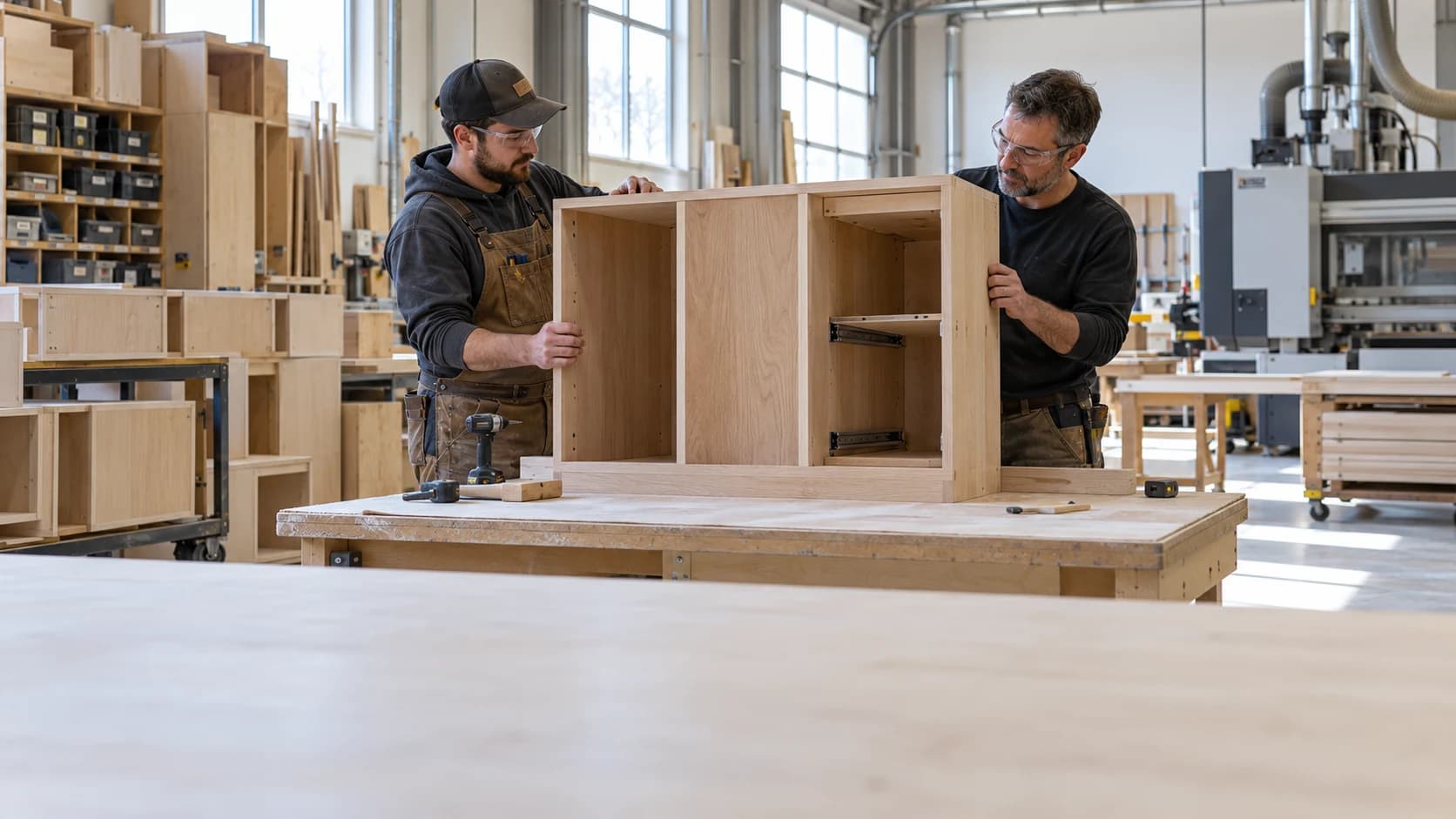
 Cabinet Shop Operations: What to Standardize First
Woodworking2 min read
Cabinet Shop Operations: What to Standardize First
Standardize the handoffs that repeatedly create confusion before documenting every activity in the business.
Archive ·Review ten areas of millwork operations, including materials, production flow, labour records, quality checks, and communication.
10 Best Practices for Maximizing Millwork Shop EfficiencyThe competitive landscape of millwork manufacturing demands operational excellence. In 2026, the U.S. millwork market is projected to grow to $18.4 billion by 2032, highlighting the need for shops to optimize every aspect of their operations according to AnythingResearch. Efficiency directly impacts profitability, customer satisfaction, and team morale. A truly efficient millwork shop in 2026 is one that leverages technology, streamlines processes, and empowers its workforce to reduce waste, improve throughput, and increase profitability. This involves a strategic approach to managing every stage, from initial design to final installation.
Accurate job costing prevents profit leakage on every project. Standardized costing methods ensure consistency across estimators, leading to more reliable bids. Standardized processes ensure consistent pricing and profit margins. Real-time cost tracking helps catch overruns early in the production cycle. Digital job costing platforms eliminate spreadsheet errors common in manual systems. A Midwest millwork firm saw a 20% improvement in cut list accuracy after implementing an ERP solution for precise job costing.
Balancing inventory levels is critical to avoid both costly stockouts and excess carrying costs. Implementing just-in-time ordering for high-turnover materials reduces financial waste. Digital inventory systems track material usage by job, optimizing stock levels. Just-in-time ordering minimizes storage costs and reduces material obsolescence. Better cut optimization and remnant tracking reduce waste, potentially by up to 20%. Inventory carrying costs can average 25% of an item's cost per year, making efficient management essential.
Breaking down silos between sales, production, and installation teams is essential for efficiency. Centralizing job information ensures everyone works from the same data. A single source of truth reduces errors caused by miscommunication or outdated information. Digital platforms eliminate the need for constant status check-ins and reduce email clutter. Poor communication in manufacturing can lead to significant inefficiencies and rework loops. Employees spend up to 17 hours per week sorting out misunderstandings due to miscommunication across all industries.
Automating administrative tasks frees up skilled workers from data entry and paperwork. This allows them to focus on high-value production work. Automate purchase orders, invoicing, and job status updates. Reduce human error in repetitive processes. Redirect team energy to core production tasks that drive revenue. Inefficient processes can add up to 20% more administrative work in residential construction, a proxy for millwork operations.
Cross-trained employees provide flexibility during peak periods and cover absences. Ongoing training keeps teams current with best practices and tools. Cross-trained staff can result in a 40% improvement in operational efficiency. Skilled workers produce higher quality work with less rework, reducing costly errors. Training on digital tools maximizes software ROI and improves overall productivity. Companies offering cross-training see a 29% higher employee retention rate.
Implementing clear quality control checkpoints catches errors early before they become costly rework. Establish clear quality standards at each production stage. Use digital checklists to ensure consistency across all projects. Track quality metrics to identify improvement opportunities and reduce defects. Precision and coordination are paramount in architectural millwork according to BluEntCAD. Automation in millwork shops leads to fewer rejects and callbacks.
Designing the shop floor workflow to minimize material handling and movement is crucial. Position equipment and workstations for logical job progression. Reduce wasted motion and time between production stages. Strategic layout redesigns can cut material handling distances by over 35%. Regularly reassess layout as production needs evolve to maintain efficiency. Optimized layouts can also boost floor utilization by 25% or more.
Tracking key metrics like production time, material waste, and job profitability provides actionable insights. Use historical data to improve estimating accuracy. Identify patterns in delays or cost overruns to prevent future issues. Make data-driven decisions rather than relying on gut feel. Advanced data analytics help firms extract insights for smarter planning and cost control as noted by BluEntCAD.
Management Area | Manual/Spreadsheet Approach | Efficiency Impact | |
|---|---|---|---|
Production Tracking | Whiteboards, verbal updates, manual logs | Real-time dashboards, automated status updates, digital job boards | Instant visibility, proactive bottleneck identification, reduced delays |
Job Costing Accuracy | Spreadsheets, estimates based on historical averages | Automated material/labor tracking, precise unit-of-measure conversions | Eliminates errors, prevents profit leakage, enables accurate bidding |
Manual counts, guesswork, reactive ordering | Automated usage tracking, optimized ordering, remnant management | Reduced carrying costs, minimized stockouts, less material waste | |
Inter-Department Communication | Emails, phone calls, paper notes, meetings | Centralized job data, integrated messaging, shared digital plans | Breaks down silos, reduces miscommunication, faster problem-solving |
Time to Generate Reports | Hours to days, manual data compilation | Minutes, automated data aggregation and visualization | Rapid decision-making, timely insights for continuous improvement |
Error Rate and Rework | High due to manual data entry, miscommunication, outdated info | Significantly reduced by automation, real-time data, clear workflows | Improved quality, lower costs, increased customer satisfaction |
Real-time production tracking provides instant visibility and identifies bottlenecks.
Standardized and digital job costing prevents profit loss and improves bidding accuracy.
Optimized inventory management balances stock levels, reducing waste and costs.
Streamlined communication across departments reduces errors and improves coordination.
Automating administrative tasks frees up skilled labor for high-value work.
Integrated software solutions are superior to disconnected tools for overall efficiency.
For a cabinet or millwork project, Millbase project tracking connects the job, sub-projects, tags, recorded labour, and material costs. Pair that context with inventory records when reviewing the materials used and the work still being discussed. Keep the approved drawings and manufacturer requirements available through the shop’s established document process.
Ask the Millbase AI agent a question grounded in your workspace records. For example: “Show the recorded labour and material costs for this cabinet project, and who has worked on it.” You can select a project or worker, ask follow-up questions, and request supported reports and CSV exports.
Use the answer to prepare a focused review of the job. It does not establish hardware compatibility, approve a drawing revision, or replace a manufacturer’s instructions or the contract specification.
For the broader workflow and decisions behind this guide, read A Bill of Materials for Cabinets That Survives Production Changes.
The biggest factor affecting millwork shop efficiency is often the lack of real-time visibility into production status and job costs. Without this, managers operate with incomplete information, leading to cascading inefficiencies such as missed deadlines, unexpected cost overruns, and unnecessary rework.
Millwork shops can achieve significant savings by implementing digital job costing. For example, a Texas-based architectural millwork firm achieved huge savings on time and costs, along with more accurate estimates, after adopting digital workflows. This prevents profit leakage and enables more competitive and accurate bidding decisions.
Yes, investing in millwork management software is worth it for small shops. Even small shops waste significant time and money on manual processes; software eliminates these inefficiencies. A 15-person architectural millwork shop saw a full ROI in 24 months after investing in CNC and software integration, primarily due to labor cost reduction and increased production capacity.
The most common efficiency bottlenecks in millwork production include communication gaps between departments, material delays due to poor inventory management, rework from design or production errors, and manual administrative tasks that consume valuable time. These issues collectively slow throughput and increase operational costs.
Millbase connects projects, people, workstations, recorded labour, material costs, and inventory. The Millbase AI agent can answer questions from workspace records and produce supported reports. Evaluate those workflows with a representative cabinet job and confirm any additional requirements in a demonstration.
Millwork shops should prioritize implementing real-time production tracking and digital job costing first. These foundational improvements provide immediate visibility into operations and costs, enabling data-driven decisions for all subsequent optimizations and ensuring a clear understanding of project profitability.

Writing about woodworking, millwork, and the operations behind a better-run shop.
Connect on LinkedInExplore how Millbase connects projects, people, inventory, and labor records.
Book a live demoCabinet Shop Operations: What to Standardize FirstStandardize the handoffs that repeatedly create confusion before documenting every activity in the business.
Archive ·Woodworking Process Documentation That Operators Will UseUseful process documentation supports the decision at the point of work.
Archive ·Cabinet Door and Drawer Front IdentificationDoors and drawer fronts often remain separate from their cabinet boxes through machining, finishing, and assembly.
Archive ·